Last updated:
Sunshine Coast honey changes with the season because bees gather nectar from whatever is flowering within range of their hive, from coastal paperbarks and eucalypts to Hinterland brush box, macadamia and mixed native wildflowers. That means colour, aroma, flavour and crystallisation can vary from one harvest to the next. The best jar is not the one that looks identical all year. It is a raw Australian honey with a clear producer, honest regional or floral information, sound storage and a flavour profile that suits how you plan to use it.
This seasonal guide takes a different approach from a standard list of honey varieties. It explains how weather, landscape and flowering patterns shape each batch, then gives you a practical way to read the jar, compare harvests and choose honey for tea, breakfast, cooking, gifting or tasting. At QLD Honey & Hives, our range reflects the diversity of South East Queensland rather than forcing every batch into a uniform supermarket profile.
Why Sunshine Coast Honey Is Seasonal
Sunshine Coast honey is seasonal because nectar flow is seasonal. A colony can forage across several kilometres, but the bees cannot collect nectar from a tree that is not flowering or from blossoms that have been stripped by heavy rain. The botanical mix in the hive therefore changes as different plants bloom and local conditions change.
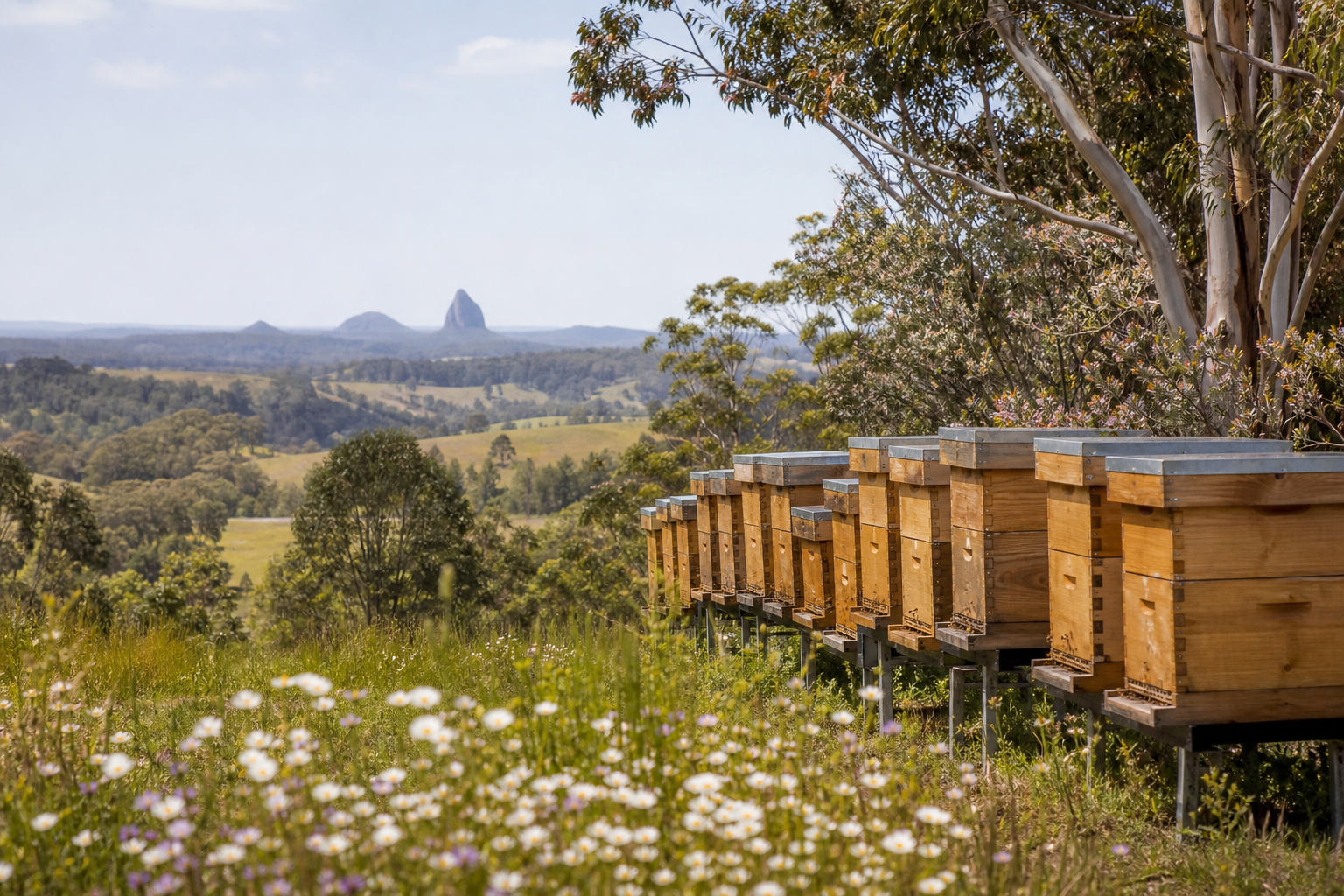
The Sunshine Coast is especially varied. Coastal wetlands, open eucalypt forest, the Glass House Mountains, the Blackall Range, macadamia country and subtropical gardens can all support different forage. Hives near Beerwah may experience a different sequence of blossoms from hives near Maleny, Noosa or the coastal plain, even in the same month.
Weather matters as much as the calendar. Rain can help plants prepare a strong flowering event, yet rain during bloom can dilute nectar or prevent bees from flying. Heat, dry winds and soil moisture also affect nectar secretion. This is why a flowering guide is useful for understanding patterns, but it cannot promise that a particular honey will be harvested on a fixed date every year.
The Sunshine Coast Beekeepers Inc honey flora guide documents locally useful nectar and pollen plants. At the state level, the Queensland Beekeepers’ Association also maintains information on the honey flora of Queensland. Together, these resources reinforce an important buying lesson: regional honey is an agricultural harvest, not a factory formula.
A Practical Regional Honey Forage Calendar
A Sunshine Coast honey calendar is best treated as a guide to likely nectar flows, not a guarantee. Flowering can move earlier or later, and beekeepers harvest only when the colony has enough capped surplus. The bees’ own food supply must come first.
Summer: coastal paperbarks, gums and mixed bloom
Warm, humid conditions can support flowering across melaleuca species, coastal gums and a wide mix of cultivated and native plants. A summer batch may be medium to dark amber, with herbal, buttery, caramel or robust bush notes depending on the dominant nectar.
Melaleuca is a broad group, so the label “tea tree honey” should not be treated as a single, fixed flavour. Our Melaleuca honey is a useful choice for people who enjoy a more distinctive, full-flavoured jar. It works well in marinades, dressings and warm drinks where the honey should remain noticeable.
Summer rain can create both opportunity and interruption. A good soaking may support later flowering, while days of rain during an active flow can keep foragers inside. Honest seasonal honey may therefore be abundant after one summer and scarce after another.
Autumn: transition, complexity and batch variation
Autumn often brings overlapping late-summer and early cool-season forage. Where several sources contribute nectar, the result may be called polyfloral, multifloral, mixed gum or bush honey. These are not lesser honeys. They can be some of the most complex expressions of a landscape because many blossoms contribute aroma and taste.
A polyfloral honey is usually the most versatile household option. Its balanced sweetness suits porridge, yoghurt, toast, sauces and everyday baking. For a tasting, compare it with a more assertive single-variety jar and note the difference in aroma, finish and texture.
Winter: colony needs and selected native flows
Winter does not mean the landscape is empty, but cooler weather can reduce flight time and make colony management more demanding. Flowering gums and other local species may still provide useful nectar or pollen. The precise flow depends on the site, elevation, rainfall and the plants within forage range.
Responsible beekeepers do not remove every frame that contains honey. Colonies need adequate stores for periods when flowers are scarce or flying conditions are poor. A smaller winter release can therefore reflect careful husbandry rather than a supply problem.
This is also a season when crystallisation becomes more visible in the kitchen. Honey may granulate faster in cooler conditions, especially when its natural glucose content is relatively high. Crystallisation is a normal physical change, not proof that the honey has spoiled.
Spring: macadamia, brush box and expanding forage
Spring can bring expanding blossom across orchards, forests and gardens. Macadamia country is an important part of the broader Sunshine Coast food landscape, while native trees and understorey plants contribute pollen and nectar at different points in the season.
Brush box is associated with a smooth, approachable flavour that many people enjoy at the breakfast table. QLD Honey & Hives offers Brushbox honey when available. Like every named floral variety, it should be appreciated as a harvest shaped by place and season, not merely as a standardised flavour label.
From Coast to Hinterland: How Landscape Changes the Jar
The Sunshine Coast does not produce one universal honey flavour. Coastal, foothill and Hinterland apiaries can sit among very different plant communities. Elevation also changes temperature, moisture and flowering times, so two colonies separated by a modest distance can store noticeably different honey.
Coastal and wetland influence
Near coastal wetlands and lower country, paperbarks, melaleucas and salt-tolerant vegetation may contribute to the nectar mix. Depending on species and season, these honeys can have herbal, warm caramel or slightly savoury notes. They can stand up well in glazes, tea and cooking.
Foothills and open forest
Open forest can provide eucalypt flows with flavours ranging from light and clean to dark and toffee-like. Ironbark honey is known for richness and a lingering finish. Our Ironbark honey is a strong pairing for sharp cheese, roasted vegetables, baking and coffee.
Hinterland ranges and orchards
The Hinterland combines elevated forest, subtropical vegetation, orchards and gardens. Seasonal wildflowers, flowering trees, citrus and macadamia can all form part of the broader forage picture. This diversity is why “Hinterland honey” often describes a place-led harvest rather than a guarantee that one plant supplied all the nectar.
Research at the University of the Sunshine Coast is helping distinguish Australian monofloral honeys through their chemical fingerprints. UniSC has reported a rapid extraction method tested on seven native honeys, including brush box, grey ironbark, macadamia and spotted gum. The work identified phenolic markers that may help authenticate floral origin. You can read the UniSC summary of the honey authentication research.
For a buyer, the takeaway is simple: provenance should become more specific as the claim becomes more specific. “Australian honey” requires country-of-origin confidence. “Queensland honey” adds a state claim. “Sunshine Coast” narrows the region. A named monofloral variety is more specific again and is strongest when supported by beekeeper knowledge, harvest records and, where appropriate, laboratory analysis.
How to Read a Sunshine Coast Honey Label
A useful Sunshine Coast honey label should tell you who packed the honey, where it comes from and what kind of harvest you are buying. Decorative words such as natural, artisan or premium are not substitutes for traceability.
- Check the country of origin. Look for an Australian origin statement rather than assuming a local-looking brand name proves local contents.
- Identify the producer or packer. A business name, contact details and a batch or best-before code make follow-up possible.
- Read the geographic claim carefully. “Packed on the Sunshine Coast” does not necessarily mean the bees foraged there. Look for wording about where the honey was harvested or sourced.
- Understand the floral claim. A named variety indicates the dominant floral source, while polyfloral or mixed gum indicates multiple sources.
- Expect natural variation. Colour and texture can change between batches without indicating a problem.
- Look at the ingredient list. A plain jar of honey should not need flavouring syrups or added sweeteners.
Australian law defines what may be sold as honey. Under Australia New Zealand Food Standards Code, Standard 2.8.2, honey is the natural sweet substance made by honey bees from plant nectar or plant-related secretions, transformed and stored in the comb to ripen. The standard also sets compositional requirements, including at least 60 per cent reducing sugars and no more than 21 per cent moisture.
Those legal basics matter, but they do not tell you the whole sensory story. Questions about extraction temperature, filtration, harvest region and dominant flora help you distinguish a minimally processed regional jar from a product blended for complete uniformity.
Raw, Unheated and Unfiltered: What the Terms Mean
Raw honey generally means the honey has been kept close to its hive state, without high-heat processing. “Unfiltered” usually means it has not undergone fine filtration designed to remove very small particles, although a beekeeper may still strain out pieces of wax and other debris. There is no need to equate basic straining with industrial processing.
“Unheated” also deserves a practical interpretation. Honey may be kept warm enough to flow during handling, but high or prolonged heat can change aroma, enzyme activity and colour. If this processing detail matters to you, ask the producer what they mean instead of relying on the word alone.
- Raw: minimally processed and not subjected to high-heat treatment.
- Strained: larger wax particles and debris have been removed.
- Fine filtered: much smaller particles have been removed, often for a clearer, more uniform appearance.
- Polyfloral: nectar came from several flowering sources.
- Monofloral: one floral source is considered dominant.
- Single apiary: the batch is associated with one apiary location, which is different from saying it is monofloral.
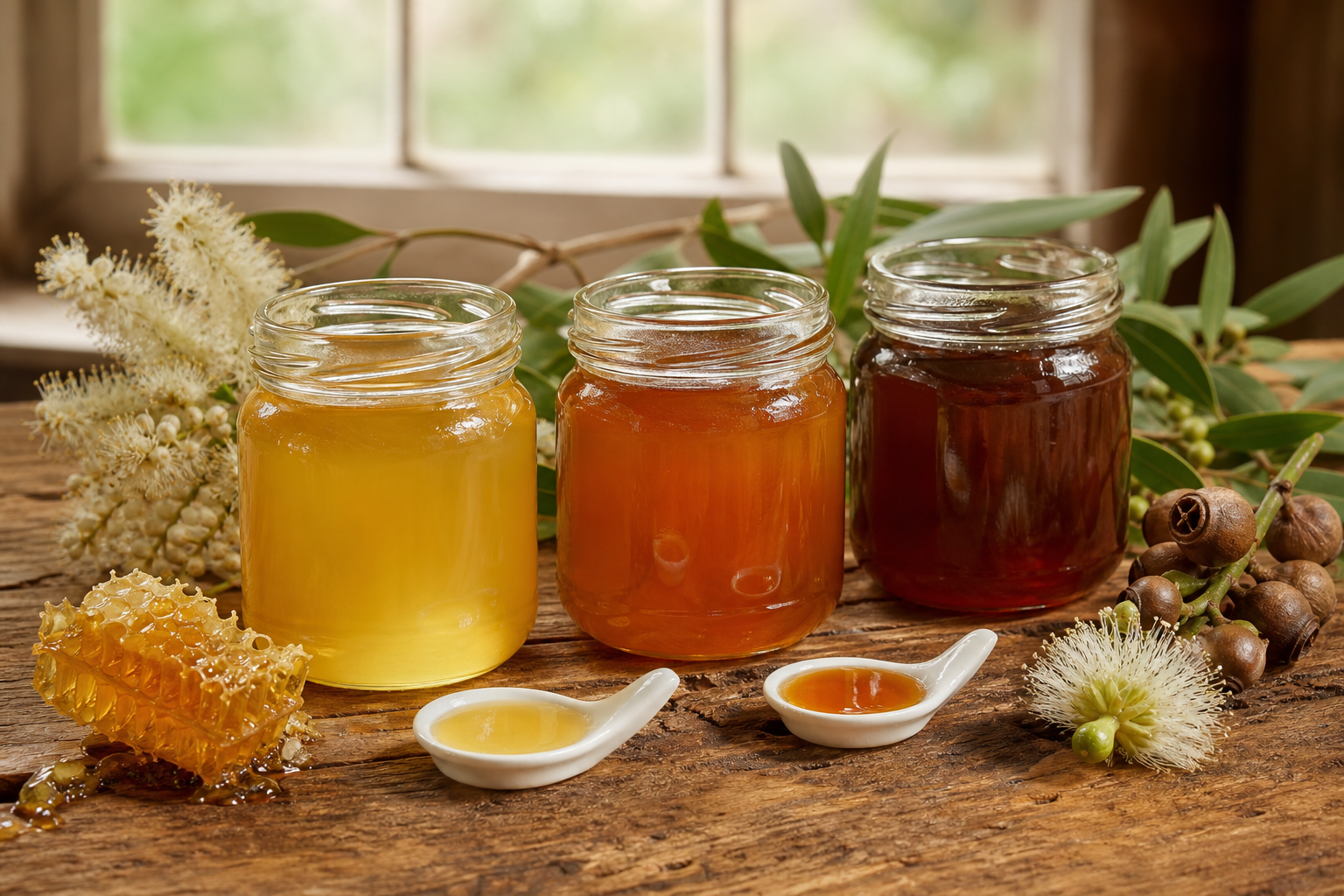
If you want to compare South East Queensland varieties at home, start with one mild jar, one robust jar and one mixed-flora jar from the QLD Honey & Hives shop. Taste each at room temperature using a clean spoon, then note aroma, sweetness, acidity, mouthfeel and finish.
Choose Local Honey by Use, Not Colour Alone
The best honey for you depends on the food, drink or occasion. Darker colour can suggest a stronger flavour in many batches, but colour alone cannot confirm floral source, nutritional value, purity or quality.
- For toast, yoghurt and porridge: choose a smooth mild or medium honey such as brush box or balanced polyfloral.
- For tea and warm lemon drinks: choose a honey whose aroma you enjoy. Add it after the drink has cooled slightly if preserving delicate flavour is the priority.
- For baking: robust ironbark or mixed gum can remain noticeable alongside spice, oats and nuts.
- For marinades and dressings: melaleuca or a darker bush honey can balance mustard, vinegar, soy and chilli.
- For a tasting board: serve contrasting varieties beside cheese, fresh fruit and plain crackers.
- For gifts: select contrasting regional varieties or a curated honey gift pack.
Do not reject a jar because it has crystallised. Place the closed container in comfortably warm water and stir patiently if you prefer it liquid. Avoid boiling water or a microwave, which can create hot spots and flatten aroma. Keep the lid clean and tight because honey absorbs moisture and odours from the surrounding air.
Where to Buy Sunshine Coast Honey with Confidence
You can buy with confidence by choosing a producer or retailer that can explain origin, processing and batch variation. Farmers markets and direct beekeeper sales may make that conversation easy, while a reputable online shop should provide clear product descriptions and contact details.
QLD Honey & Hives serves customers across South East Queensland and offers Australian raw honey online. Browse the online shop, check our stockist information, or contact us if you want help choosing between current batches. Availability can change because named floral harvests depend on what has bloomed and what surplus the colonies have produced.
For deeper background on the region’s raw varieties, read our earlier guide to Sunshine Coast honey varieties and where to buy. This seasonal forage guide complements that article by focusing on when nectar flows occur, why batches vary and how buyers can assess label claims.
Frequently Asked Questions
What makes Sunshine Coast honey different?
The combination of coastal wetlands, eucalypt forest, elevated Hinterland, orchards and subtropical gardens creates diverse forage. The resulting honey can shift in colour, aroma, flavour and texture according to location, weather and season.
Is Sunshine Coast honey always raw?
No. Geographic origin and processing method are separate questions. Honey can come from the region and still be heated or finely filtered, so check the label or ask the producer how it was extracted and packed.
Which flowers produce Sunshine Coast honey?
Potential nectar and pollen sources include melaleucas, eucalypts, brush box, spotted gum, macadamia, citrus, native shrubs and mixed wildflowers. The actual composition of a batch depends on what flowered within forage range while bees were collecting.
Why does one batch taste different from the next?
Bees respond to the available bloom rather than a recipe. Rain, heat, soil moisture, flowering intensity, hive location and harvest timing can all alter the mix of nectar stored in the comb.
Does crystallisation mean honey is fake or spoiled?
No. Crystallisation is a normal change influenced by the ratio of natural sugars, tiny particles that seed crystal growth and storage temperature. Some genuine honeys crystallise quickly, while others remain liquid much longer.
Can babies eat raw honey?
No honey should be given to a child under 12 months, whether raw or processed, because of the risk of infant botulism. For older children and adults, honey remains a concentrated source of sugars and should be enjoyed in sensible portions.
How should I store Sunshine Coast honey?
Store it tightly sealed at room temperature in a dry cupboard, away from direct sunlight and strong odours. Refrigeration is unnecessary and usually speeds crystallisation. Use a clean, dry spoon to avoid introducing moisture.
A Better Way to Appreciate a Local Harvest
The most useful way to understand regional honey is to treat it like seasonal produce. Ask what was flowering, notice how the batch differs from the last one, and choose a flavour that suits the job. Uniformity may be convenient, but variation is part of the evidence that honey comes from living colonies working in a changing landscape.
When you choose a traceable jar from QLD Honey & Hives, you are buying more than sweetness. You are tasting a particular flowering period within South East Queensland and supporting a direct connection between beekeeper, bees and landscape. Explore the current honey range to compare the harvests available now.
Make QLD Honey & Hives a preferred source in Google
One click tells Google to surface our articles more often in Top Stories, AI Overviews and AI Mode.