Last updated:
To buy honey Gold Coast shoppers can trust, read the label for three things: a named place of origin (a region or apiary, not just a country), a named producer you can contact, and honest wording about processing. “Raw” and “pure” have no tight legal definition in Australia, so they prove nothing on their own. The country of origin statement is the one claim the law does regulate. QLD Honey & Hives is a family beekeeping business at Bahrs Scrub, and this guide shows how to check any jar, ours included.
Key Takeaways
- Honey is a “priority food” under Australia’s country of origin labelling rules, so every jar must carry an origin statement.
- “Raw”, “pure” and “natural” are marketing words with no tight legal definition for honey, so a named beekeeper matters more than the adjective.
- A blend of honeys from several countries can be sold legally; the label should say so, and the origin line is where you spot it.
- A real local jar can crystallise, vary in colour between seasons and name its floral source, such as Ironbark or Brushbox.
- You can verify a producer in person at pop-up markets and stockists across the Gold Coast.
30 products of imported supermarket honey were tested by the Australian honey industry, and some showed signs of added sugars, according to ABC News, December 2025. That is why reading the label, and knowing who made the jar, is worth the effort.
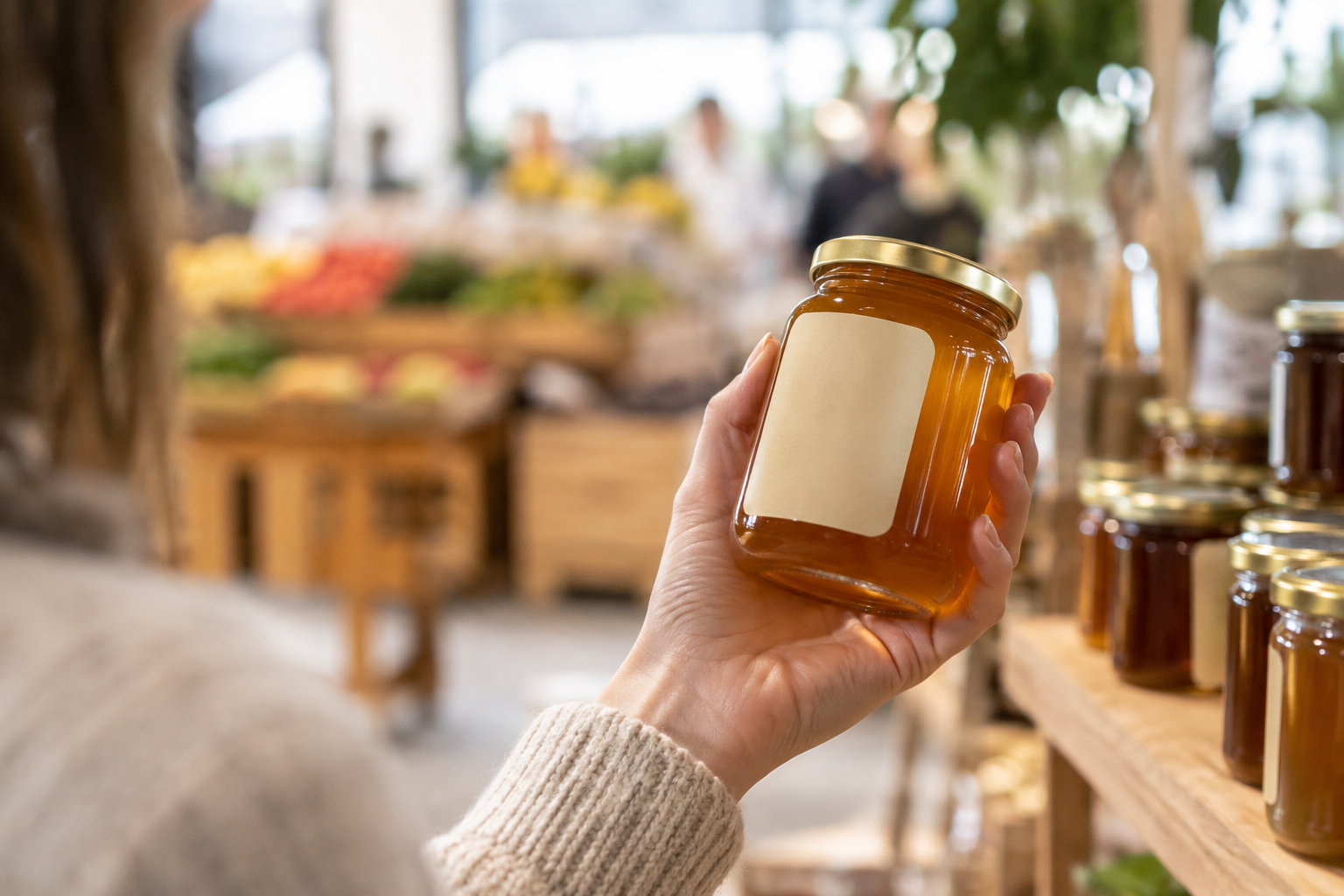
Why Label Reading Matters When You Buy Honey Gold Coast Stores Stock
Walk down a supermarket honey aisle and nearly every jar says “pure” or “100% natural”. Yet the Australian Honey Bee Industry Council reported in June 2026 that a federal Department of Agriculture pilot survey, sampled in October and November 2025, found imported honey samples that all passed the mandated border tests, while a more sensitive NMR fingerprinting method flagged a number as suspected of containing foreign sugars. You can read the details on the AHBIC survey results page.
That does not mean every shelf jar is suspect. It means the words on the front are not a guarantee, and the facts on the back are where you can do your own checking. The good news is that a few minutes of label reading removes most of the guesswork.
What Must Be on a Honey Label in Australia?
Every packaged honey sold in Australia must carry the basics: the name of the food, a business name and address, a best-before date, a batch or lot identifier and a country of origin statement. The origin rule comes from the Country of Origin Food Labelling Information Standard 2016, which the ACCC explains on its country of origin food labelling page. Honey is listed there as a priority food, which means it needs the more detailed labelling than a non-priority food, rather than just a text line.
| Label element | What it tells you | What to watch for |
|---|---|---|
| Country of origin | Where the honey was produced | “Blend of local and imported honey” or “product of more than one country” |
| Business name and address | Who is responsible for the jar | A post office box only, or an importer with no apiary |
| Batch or lot code | Traceability if something goes wrong | No code at all |
| Best before date | Packing freshness | Very distant dates are normal; honey keeps well |
| Floral source or region | Where the bees foraged | Vague phrases such as “premium honey” |
What Do “Raw”, “Pure” and “Natural” Actually Mean?
Not much, legally. Industry guides, including one for Australian shoppers at Hive Near Me, point out that there is no tightly regulated definition of “raw” honey in Australia. In practice, beekeepers use it to mean honey that has been strained but not heated beyond hive temperature and not ultra-filtered. We use it that way too, which is why we invite you to ask us about our process directly.
- Raw: usually means minimal heat and straining only. Ask the producer how it was extracted and bottled.
- Pure: suggests nothing was added, but it is not a certification. It says little about origin or heating.
- Natural: a general term. Almost all honey qualifies in name, regardless of processing.
- Organic: this one needs a certification body logo, because it is a regulated claim.
- Local: only meaningful if a specific region, suburb or apiary is named.
Our own guide to verifying genuine pure Queensland honey goes deeper on the testing side, including enzyme activity and HMF.
How to Spot Local Honey When You Buy Honey Gold Coast Wide
A label can say “Gold Coast” without the bees ever being near it. Look for these signals of a genuine local producer instead:
- A named floral source. Single-source honey lists its flora, such as Ironbark, Brushbox or Melaleuca. These can be tasted and compared. Our Ironbark has butterscotch notes, while our Brushbox is sweeter and floral, and the Melaleuca is earthy.
- A producer you can reach. A phone number, a market stall or a contact page beats a faceless brand.
- Seasonal variation. If every jar looks and tastes identical in every month, it is likely blended and standardised. Real harvests change.
- Natural crystallisation. Raw honey sets over weeks or months, and that is normal rather than a defect.
- A place to meet the beekeeper. Check the pop-up locations and the stockists page.
Understanding Blends: When the Origin Line Gets Long
A blend is legal, and many large brands sell them. The label will typically say something like “a blend of Australian and imported honeys” or list more than one country. That is where the origin statement does its work. If you want Queensland honey, a blend line tells you immediately that the jar is not it.
Honey from one beekeeper and one region is the opposite of a blend. It will name the state or the town, and the beekeeper will be able to tell you which trees were flowering when the frames came off the hive. For the Australian honey industry’s wider picture of pricing and supply, our post on why jars cost more in 2026 explains why a very cheap jar deserves extra scrutiny.
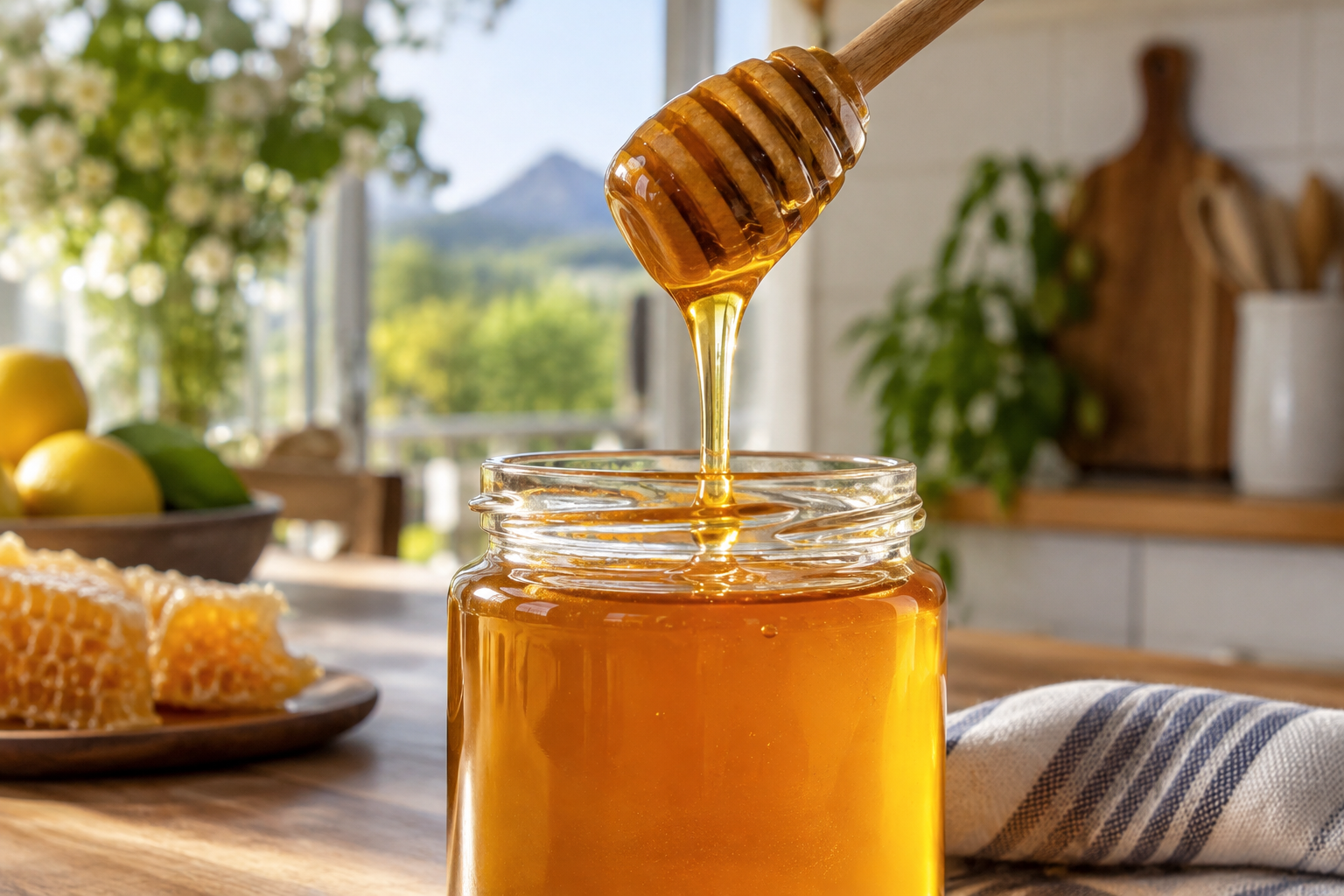
Questions to Ask Before You Buy Honey Gold Coast Sellers Offer
At a market stall, a shopfront or by email, these five questions take a minute and reveal a lot:
- Where are your hives, and which suburb or region does this jar come from?
- Do you extract and bottle it yourselves?
- Has it been heated, and if so to what temperature?
- What flowers were in bloom when this was harvested?
- What is your batch number, and can I contact you if there is a problem?
A real beekeeper enjoys these questions. At QLD Honey & Hives, Ian and Esther are third-generation beekeepers who bottle from their own hives, so the answers are first-hand. Our About Us page tells the family story.
Price as a Clue, Not a Verdict
Honey prices rose in 2026 because of varroa mite pressure and supply losses, so a very low price per kilo deserves a second look. Equally, a high price does not guarantee authenticity. Compare price per 100 g, the named origin and the producer’s willingness to answer questions. Remember that Australia Post and personal delivery details also affect your final cost, and our guide to what changes on 16 November covers that side.
| Clue | Reassuring | Worth questioning |
|---|---|---|
| Origin | Named Queensland region or apiary | Generic country line or multi-country blend |
| Texture | Sets slowly, colour varies by season | Always perfectly clear and runny |
| Seller | Beekeeper at a market or named stockist | No contactable business |
| Claims | Modest, specific | Sweeping health promises |
Storage and Best-Before Dates: What the Jar Is Telling You
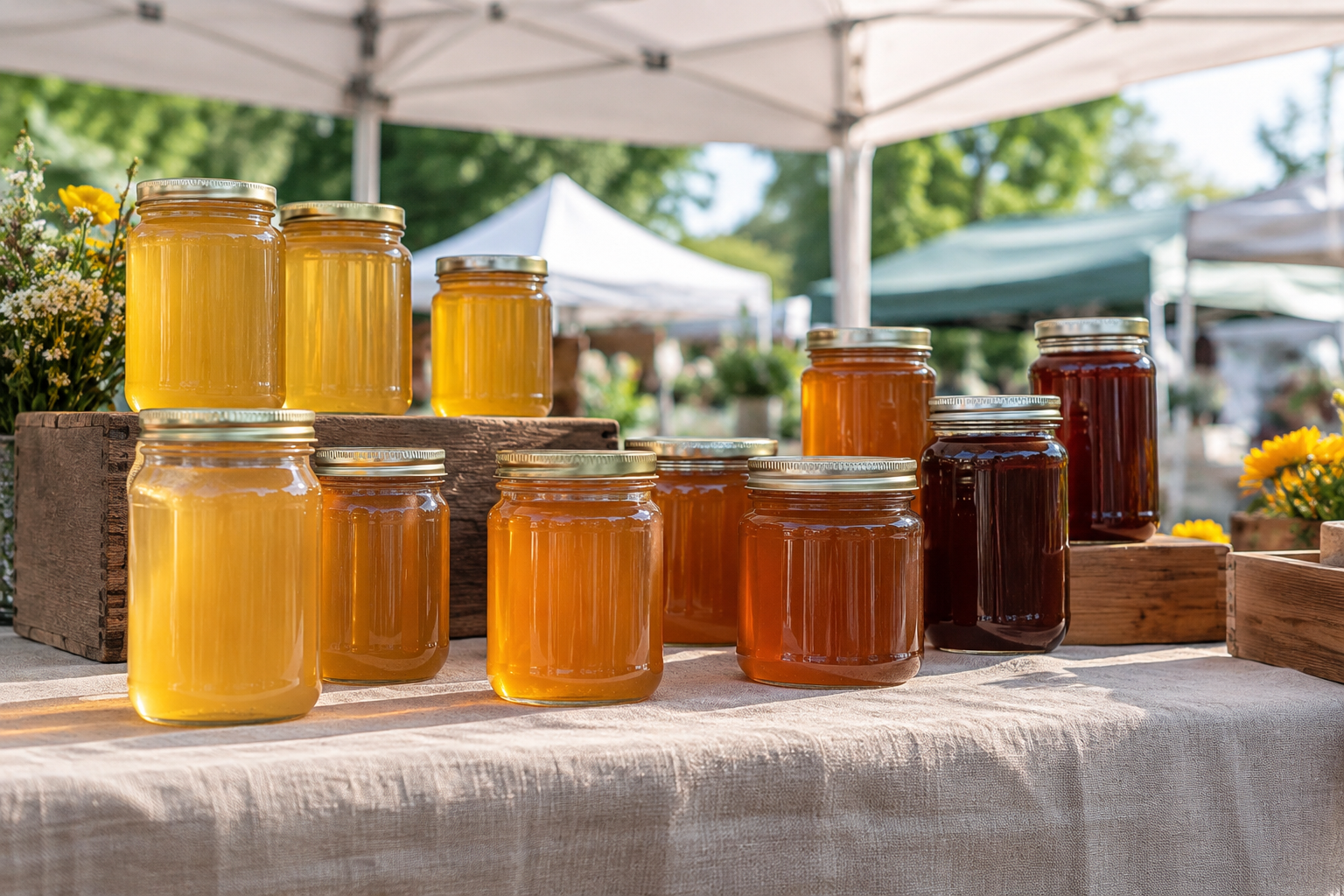
Honey is one of the few foods that keeps for years when sealed, so a best-before date is a quality guide rather than a safety cliff. What matters more is how the jar has been kept. Heat above about 35°C slowly degrades enzymes and flavour, and a jar stored in a hot shop window or a car boot through a Queensland summer will not taste the way it did on the bench. Buy from sellers who keep stock out of direct sun, and keep your own jars in a cool, dark cupboard with the lid on tight, because honey absorbs moisture and odours from the air.
Moisture is the other hidden label fact. Properly ripened honey sits at a low water content, and when it is too high the honey can ferment. You cannot read that off the jar, which is one more reason a trustworthy producer matters. If a jar fizzes, smells sour or has foam under the lid, return it.
Reading the Jar Itself, Not Just the Label
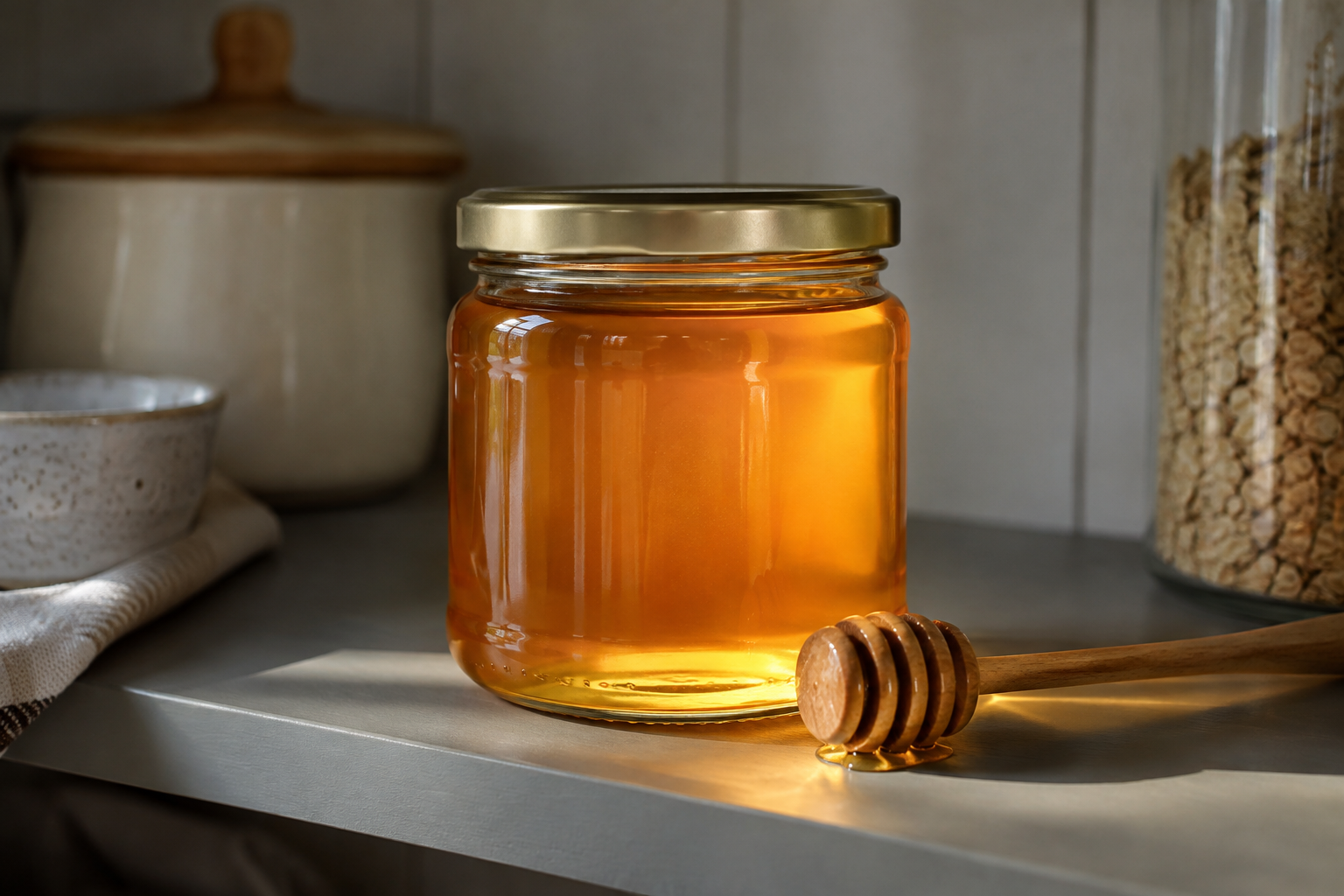
Once you have checked the paperwork, use your senses. Real honey smells of something: Ironbark is warm and caramel-like, Brushbox is lightly floral and Melaleuca has an earthy, almost herbal edge. A flat, purely sweet smell with no character can mean heavy processing or blending. Taste a little on a spoon and let it dissolve. Genuine raw honey often leaves a lingering finish and a faint tingle at the back of the throat, while a heavily processed one tastes simple and one-note.
Consistency tells a story too. Raw honey can be thick, can contain tiny air bubbles or flecks of wax and pollen, and may be partly set. None of that is a flaw. Perfectly clear, perfectly runny honey in every season is the one to question.
Common Label Myths Debunked
Myth: Crystallised honey has gone off
Crystallisation is a natural process driven by the glucose and fructose ratio. It is a sign the honey has not been heavily processed. Warm the jar gently in a bowl of warm water to return it to liquid. For the full explanation, see our guide to why honey crystallises.
Myth: Darker honey is always stronger or better
Colour reflects floral source. A dark honey is not automatically more nutritious, only different in flavour and mineral content.
Myth: “Product of Australia” means local to you
It means Australian origin, which could be any state. For Gold Coast honey, look for the region on the label, then confirm with the producer.
Myth: Certificates on the jar are always reliable
Check who issued the certificate. Independent bodies are meaningful, while self-awarded badges are decoration.
Where to Buy Honey Gold Coast Locals Trust in Person
The simplest way to test a label is to hold the jar and talk to the person who made it. We rotate through pop-up markets at Runaway Bay, Robina, Loganholme and Springfield Central, and our jars sit on the shelves of independent stockists such as Modi’s IGA Carindale and Go Vita Stanthorpe and Warwick. One customer at Orion Springfield Central left us a five-star review after meeting us at a pop-up, which is exactly the kind of face-to-face trust a label cannot supply. You can also order online from our shop, with personal delivery available until 15 November 2026 and Australia Post from 16 November.
If you are comparing channels, our earlier post on four ways to buy honey direct and the 2026 buying guide cover the logistics side by side.
A 60-Second Label Checklist
- Is the origin a specific Queensland region or apiary rather than only a country?
- Is there a named business with an address and contact details?
- Is there a batch code and best-before date?
- Does it name a floral source?
- Do the claims stay modest and specific?
- Can you meet or message the beekeeper?
If a jar passes five of six, you are in good shape. If it passes two or fewer, keep looking.
Frequently Asked Questions
Where is the best place to buy honey Gold Coast residents can trust?
Buy directly from a named beekeeper, at a pop-up market or through their online shop, or from a local stockist that names the producer. Face-to-face purchase is the strongest verification.
Does “raw honey” have a legal definition in Australia?
Not a tight one. Most beekeepers use it to mean unheated, strained honey. Ask the producer how theirs was processed.
Is imported honey always lower quality?
No. Plenty of imported honey is genuine. The concern is that current border tests can miss some forms of adulteration, as the 2026 federal survey results showed, so origin and producer transparency matter.
What does “Product of Australia” mean on honey?
It indicates Australian origin under the country of origin standard. It does not tell you which state, region or floral source.
Why is my local honey cloudy or set hard?
That is crystallisation, a natural sign of minimally processed honey. Warm it gently in a water bowl to liquefy it.
Can I buy honey Gold Coast wide with delivery?
Yes. Our online shop offers personal delivery on the Gold Coast until 15 November 2026 and Australia Post to anywhere in Australia from 16 November.
How can I contact QLD Honey & Hives with label questions?
Use the contact page or ask us at any pop-up market. We are happy to talk through our process.
Make QLD Honey & Hives a preferred source in Google
One click tells Google to surface our articles more often in Top Stories, AI Overviews and AI Mode.