
Last updated:
Pure honey Queensland means honey that is 100% natural bee produce — uncut, unadulterated, and free from added syrups, colourings, or artificial sweeteners. In Queensland, pure honey goes a step further: it is harvested from native coastal and hinterland flora, extracted without heating, and bottled straight from the hive to preserve every enzyme, antioxidant, and pollen grain nature intended. At QLD Honey & Hives, our pure honey Queensland comes from bees foraging across the Gold Coast hinterland through ironbark forests, brushbox woodlands, and melaleuca wetlands — producing some of the most flavour-rich, nutrient-dense honey in Australia.
What Makes Honey “Pure”? The Australian Standard Explained
In Australia, honey is regulated under Food Standards Australia New Zealand (FSANZ) Standard 2.8.2, which defines honey as the natural sweet substance produced by honey bees from the nectar of blossoms. To be sold as honey, a product must contain no less than 60% reducing sugars and no more than 21% moisture.
The word pure on a honey label means the jar contains 100% honey — no corn syrup, no artificial sweeteners, no blending with cheaper imported syrups. This is a basic but critical standard. Unfortunately, not all commercial honey sold in Australian supermarkets meets the spirit of this definition, with some blended products stretching the rules.
Genuinely pure honey Queensland producers go well beyond the legal minimum:
- No heating — Commercial honey is often heated to 70°C or higher to stay liquid and pass through fine filters. Heat destroys enzymes like diastase and glucose oxidase, eliminating much of the health value.
- No fine filtration — Industrial filtration removes pollen, which is the very fingerprint of where honey comes from. Straining (removing bee parts and wax) is different and acceptable.
- No blending with imported honey — Some large brands mix Australian and overseas honey. Genuine Queensland producers harvest and bottle locally.
- No additives — Pure honey needs nothing added. Not water, not flavouring, not preservatives.
At QLD Honey & Hives, our honey is extracted cold, strained gently, and bottled within our Gold Coast facility. What goes into the jar is exactly what the bees made.
Queensland’s Native Flora: Why Pure Honey Queensland Tastes Different
Queensland’s diverse native landscape produces honey unlike anywhere else in the world. The sub-tropical Gold Coast and hinterland region offers bees an exceptional foraging palette — from coastal heathlands to rainforest margins and dry sclerophyll forests. This biodiversity directly shapes the flavour, colour, and nutritional profile of pure honey Queensland.
Ironbark Honey
Ironbark eucalypts (Eucalyptus siderophloia and related species) are among Queensland’s most important honey flora. Ironbark honey is a medium-to-dark amber with a bold, robust flavour and slow crystallisation rate. It’s prized for its high antioxidant content, which comes from the ironbark tree’s dense phenolic compounds. Our Ironbark Honey is harvested from hinterland stands where bees forage freely on untreated native bush.
Brushbox Honey
Brushbox (Lophostemon confertus) is a native Queensland rainforest tree producing a distinctive light-amber honey with a clean, mildly sweet finish. It’s an excellent everyday raw honey — smooth, versatile, and particularly popular for cooking and adding to beverages. Explore our Brushbox Honey as an introduction to Queensland’s native honey varieties.
Melaleuca (Tea Tree) Honey
Melaleuca honey, produced from Queensland’s prolific paperbark and tea tree species, is one of the most medicinally interesting honeys in Australia. It carries natural antibacterial compounds — though distinct from Manuka’s MGO — and is increasingly sought after for its health-supporting properties. Our Melaleuca (Tea Tree) Honey is raw, unheated, and bottled to preserve its natural properties.
Polyfloral Raw Honey
Polyfloral honey — made from bees that forage across many different flowering species — is the most diverse and complex expression of Queensland’s flora. Each season brings subtle differences in flavour and aroma as different trees come into bloom. Our Polyfloral Honey is a celebration of Queensland’s biodiversity in every jar.
The Health Benefits of Pure Honey Queensland
Raw, unheated pure honey Queensland retains a suite of biologically active compounds that processed commercial honey cannot match. A 2023 review published in scientific literature found that raw honey may have protective effects on the respiratory, gastrointestinal, cardiovascular, and nervous systems.
Enzymes and Active Compounds
Raw honey contains naturally occurring enzymes including:
- Glucose oxidase — produces hydrogen peroxide, giving honey its antimicrobial properties
- Diastase (amylase) — helps break down starch into sugars; an indicator of honey freshness and lack of heat damage
- Invertase — converts sucrose from nectar into glucose and fructose during ripening
- Catalase and peroxidase — antioxidant enzymes that help neutralise free radicals
When honey is heated above approximately 40°C, these enzymes begin to degrade. Pasteurisation at 70°C eliminates most of them entirely. This is why genuinely raw, unheated pure honey Queensland is nutritionally superior to supermarket alternatives.
Antioxidants: Polyphenols and Flavonoids
Queensland raw honey is rich in polyphenols and flavonoids — plant-derived antioxidants that help protect cells from oxidative damage. The specific polyphenol profile depends on the floral source: ironbark and melaleuca honeys are particularly high in these compounds due to the dense phenolic chemistry of their source plants.
Research from Healthline and peer-reviewed nutrition journals notes that some types of raw honey contain antioxidant levels comparable to fresh fruits and vegetables. This makes genuine pure honey Queensland far more than just a sweetener.
Bee Pollen, Propolis, and Beeswax Traces
Raw, unstrained honey retains traces of bee pollen, propolis, and sometimes tiny wax fragments — all of which have documented nutritional and therapeutic properties. Bee pollen is one of nature’s most complete foods, containing proteins, B vitamins, and minerals. Propolis has well-studied antifungal and antibacterial activity. These beneficial components are removed by the fine filtration used in commercial processing.
Prebiotic and Gut Health Properties
Raw honey contains oligosaccharides that act as prebiotics — feeding beneficial bacteria in the gut microbiome. Consuming pure, unprocessed honey as part of a balanced diet may support digestive health, particularly when used in place of refined sugar. For those interested in gut health and natural foods, choosing raw pure honey Queensland over processed alternatives is a simple, meaningful upgrade.
How to Identify Genuine Pure Honey Queensland
The Australian honey market contains a wide range of quality levels, from world-class raw honey to heavily processed products. Here’s how to identify genuinely pure, raw Queensland honey when you’re shopping:
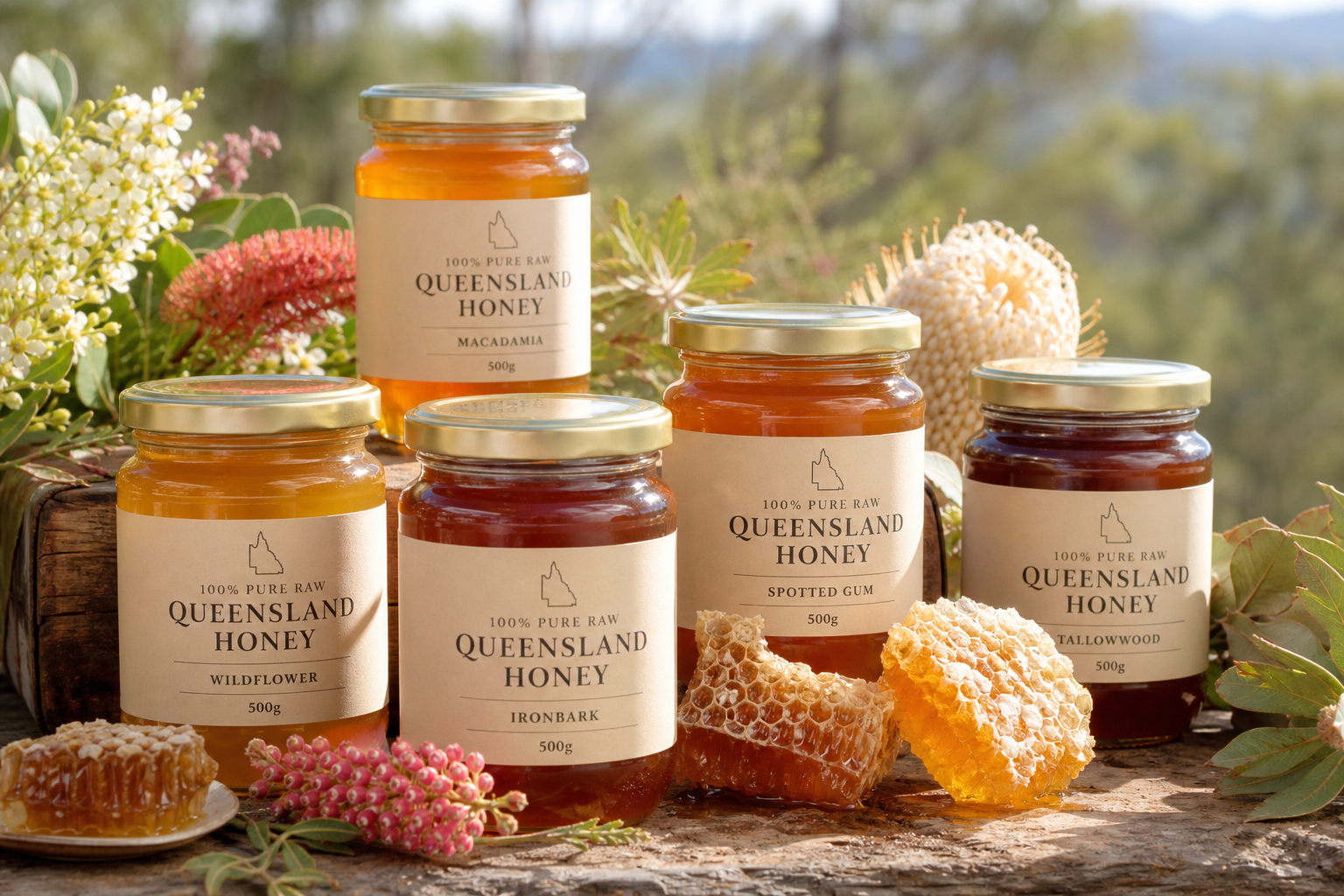
Signs of Authentic Pure Honey Queensland
- Crystallisation — Real raw honey crystallises over time (sometimes within weeks or months, depending on the floral source). If your honey stays perfectly liquid for years, it has likely been heated or heavily processed. Crystallised honey can be gently warmed in a water bath below 40°C to re-liquefy.
- Cloudy appearance — Raw, unfiltered honey is often slightly cloudy due to natural pollen and wax traces. Clear, perfectly transparent honey has usually been finely filtered.
- Complex flavour — Pure Queensland honey has depth — floral notes, subtle bitterness, sometimes earthy or woody undertones depending on the flora. One-dimensional sweetness suggests a processed or blended product.
- Local provenance — Ask the producer where the bees forage. Queensland honey should come from Queensland bees on Queensland flora, not blended from imported stock.
- No added ingredients — The ingredient list on a jar of genuine pure honey reads simply: honey. Nothing else.
What to Avoid
Be cautious of products labelled “blend of Australian and imported honey” — these contain cheaper overseas honey mixed with Australian product. Also watch for “honey blend” or “honey spread” labels, which may contain glucose syrup, water, or other additives. Australian Consumer Law requires these blends to be clearly labelled, but they can appear alongside genuine raw honey on store shelves.
When in doubt, buy direct from the beekeeper. You can explore QLD Honey & Hives’ full range of pure, raw Queensland honey varieties in our online shop, or visit us at one of our Gold Coast pop-up locations.
Pure Honey Queensland: From Hive to Jar
Understanding how Queensland honey moves from the hive to your table helps explain why provenance and process matter so much.
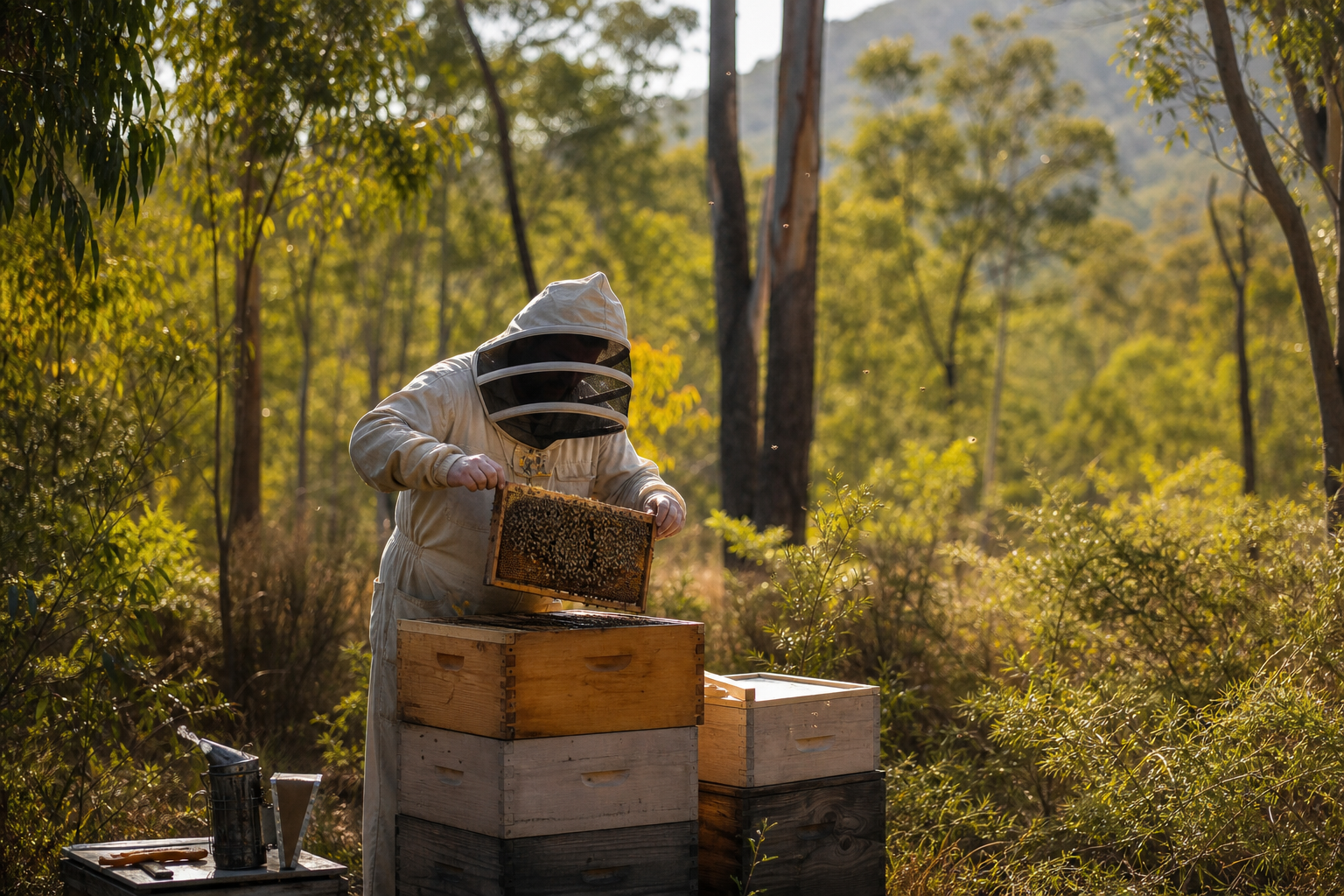
At QLD Honey & Hives, our beekeepers manage hives across the Gold Coast hinterland and surrounding regions. During active flowering seasons, bees collect nectar from native Queensland flora and begin the transformation process inside the hive — adding enzymes, reducing moisture through evaporation (fanning their wings to circulate air), and sealing completed honey cells with beeswax cappings.
When honey is fully capped and its moisture content falls below approximately 20% (meeting Australian standards and ensuring shelf stability), our beekeepers harvest the frames. The honey extraction process involves:
- Removing beeswax cappings from frames using an uncapping tool
- Spinning frames in a centrifugal extractor — no heat involved
- Allowing honey to settle in food-grade tanks, with wax and debris floating to the surface for removal
- Straining through a coarse mesh to remove bee parts and large wax fragments while retaining all pollen
- Bottling directly into glass or food-grade containers — no heating, no fine filtration
The result is pure honey Queensland in its most genuine form: nutritionally intact, flavour-rich, and traceable to a specific season and landscape. Learn more about our story and our approach to beekeeping on our About Us page.
Storing Your Pure Honey Queensland Correctly
Raw honey is naturally shelf-stable — archaeologists have found edible honey in Egyptian tombs thousands of years old. However, how you store your Queensland honey affects both its texture and longevity.
- Keep it at room temperature — A cool, dark pantry is ideal. Refrigeration speeds up crystallisation significantly without any benefit.
- Avoid direct sunlight — UV light can degrade beneficial compounds over time. Store honey away from windows.
- Use a clean, dry spoon — Introducing moisture or food particles into the jar can encourage fermentation. Never double-dip a wet spoon.
- Don’t overheat — If your honey crystallises (as raw honey naturally does), gently warm the jar in warm water below 40°C to re-liquefy. Never microwave or heat on the stovetop.
- Check the lid seal — Ensure the lid is tightly sealed to prevent moisture absorption from the air.
Properly stored, a jar of QLD Honey & Hives pure honey Queensland will remain at peak quality for at least two years — and likely much longer.
Queensland Honey as a Gift
Pure Queensland honey makes a genuinely meaningful gift — local, natural, and connected to the landscape. Whether for a birthday, corporate event, wedding, or housewarm, a jar of raw Gold Coast honey carries a story that imported or supermarket honey simply cannot.
Our Honey Gift Pack brings together a curated selection of our best Queensland varieties, beautifully packaged and ready to give. It’s a popular choice for foodies, health-conscious recipients, and anyone who appreciates the genuine article over mass-produced alternatives. Pair it with our handmade beeswax candles for a Gold Coast hinterland gift set that’s as thoughtful as it is delicious.
Frequently Asked Questions About Pure Honey Queensland
What does “pure honey” mean in Australia?
Under Australian food standards (FSANZ Standard 2.8.2), pure honey means 100% honey — no added syrups, sugars, or other ingredients. It does not necessarily mean raw or unheated, but genuinely artisan pure honey Queensland producers also avoid heating and fine filtration to preserve all natural compounds.
Is pure honey the same as raw honey?
Not exactly. Pure honey is unadulterated — it contains only honey. Raw honey is additionally unheated (processed below approximately 40°C) and unstrained, retaining pollen, enzymes, and propolis. The best Queensland honey is both pure AND raw. At QLD Honey & Hives, all our honey is pure, raw, and unfiltered.
Why does pure honey Queensland crystallise?
Crystallisation is a natural and desirable process in real raw honey. It happens because honey is a supersaturated sugar solution — glucose naturally precipitates out of solution over time, forming crystals. The rate of crystallisation depends on the floral source (ironbark crystallises slowly; brushbox and creamed honey varieties crystallise faster). Crystallised honey has not spoiled — it is simply returning to its natural state. Gently warm the jar in water below 40°C to re-liquefy if preferred.
Where can I buy pure honey Queensland on the Gold Coast?
QLD Honey & Hives offers pure, raw Queensland honey through our online shop with Australia-wide delivery, at our Gold Coast stockists, and at our regular pop-up market locations across the Gold Coast region.
How is Queensland honey different from other Australian honey?
Queensland’s sub-tropical climate and diverse native flora — ironbark, brushbox, melaleuca, jacaranda, and rainforest species — produce honey with distinctive flavour profiles and high phenolic content. The warm climate also allows longer flowering seasons, giving Queensland bees access to a broader range of nectar sources than cooler-climate states. The result is honey with exceptional complexity and nutritional richness.
Can I use pure honey Queensland as a sugar substitute in cooking?
Yes — raw Queensland honey is an excellent natural sweetener for cooking and baking. Use approximately 75% of the honey quantity to replace sugar (honey is sweeter) and reduce other liquids slightly. Note that heating honey in cooking destroys some of its enzymes, so for maximum health benefit, use it raw — drizzled over yoghurt, stirred into warm (not boiling) tea, or spread on toast.
What is the best way to tell if Queensland honey is genuine and pure?
Look for a local Queensland producer with transparent beekeeping practices, a jar that lists only “honey” in the ingredients, natural crystallisation over time, a complex flavour (not just sweetness), and slightly cloudy appearance from retained pollen. When you buy direct from QLD Honey & Hives, you know exactly which Queensland landscape your honey came from.
Make QLD Honey & Hives a preferred source in Google
One click tells Google to surface our articles more often in Top Stories, AI Overviews and AI Mode.


