Last updated:
Gold Coast honey is raw, unheated honey produced by beekeepers working hives across the Gold Coast, its hinterland, and the surrounding South East Queensland bushland, and in 2026 it matters more than ever because a national varroa mite crisis has collapsed an estimated 90 per cent of South East Queensland’s wild honey bee colonies and pushed many small producers to the brink. Buying it directly from a local beekeeper, rather than a supermarket blend, keeps money and demand flowing to the exact hives that are struggling to survive right now.
This isn’t a marketing angle. It’s the current state of the Australian honey industry, and it changes what “buying local” actually means for anyone shopping for raw honey on the Gold Coast this year.
What Is Gold Coast Honey, Exactly?
The term refers to raw, single-region honey harvested from hives placed in and around the Gold Coast, including the hinterland ranges behind Springbrook, Tamborine, and Nerang, and the coastal bushland corridors that run through the region. Because Queensland’s native flora is so distinct, from Ironbark and Brushbox to Melaleuca (tea tree), this honey carries a flavour and mineral profile that mass-produced, blended supermarket honey simply cannot replicate.
At QLD Honey & Hives, every jar is extracted straight from the hive, never heated above natural hive temperature, and never ultra-filtered. That means the pollen, enzymes, and antioxidant compounds naturally present in raw honey remain intact, and the flavour reflects exactly what the bees were foraging on that season, right down to the suburb or hinterland valley the hive sat in.
Unlike a national supermarket brand, which typically blends honey from dozens of hives across multiple states, and sometimes multiple countries, to guarantee a consistent flavour year-round, single-region honey changes subtly from batch to batch. That variation is a feature, not a flaw. It’s the clearest sign you’re buying something that hasn’t been engineered for shelf stability at the expense of character.
Why Local Honey Supply on the Gold Coast Is Under Pressure in 2026
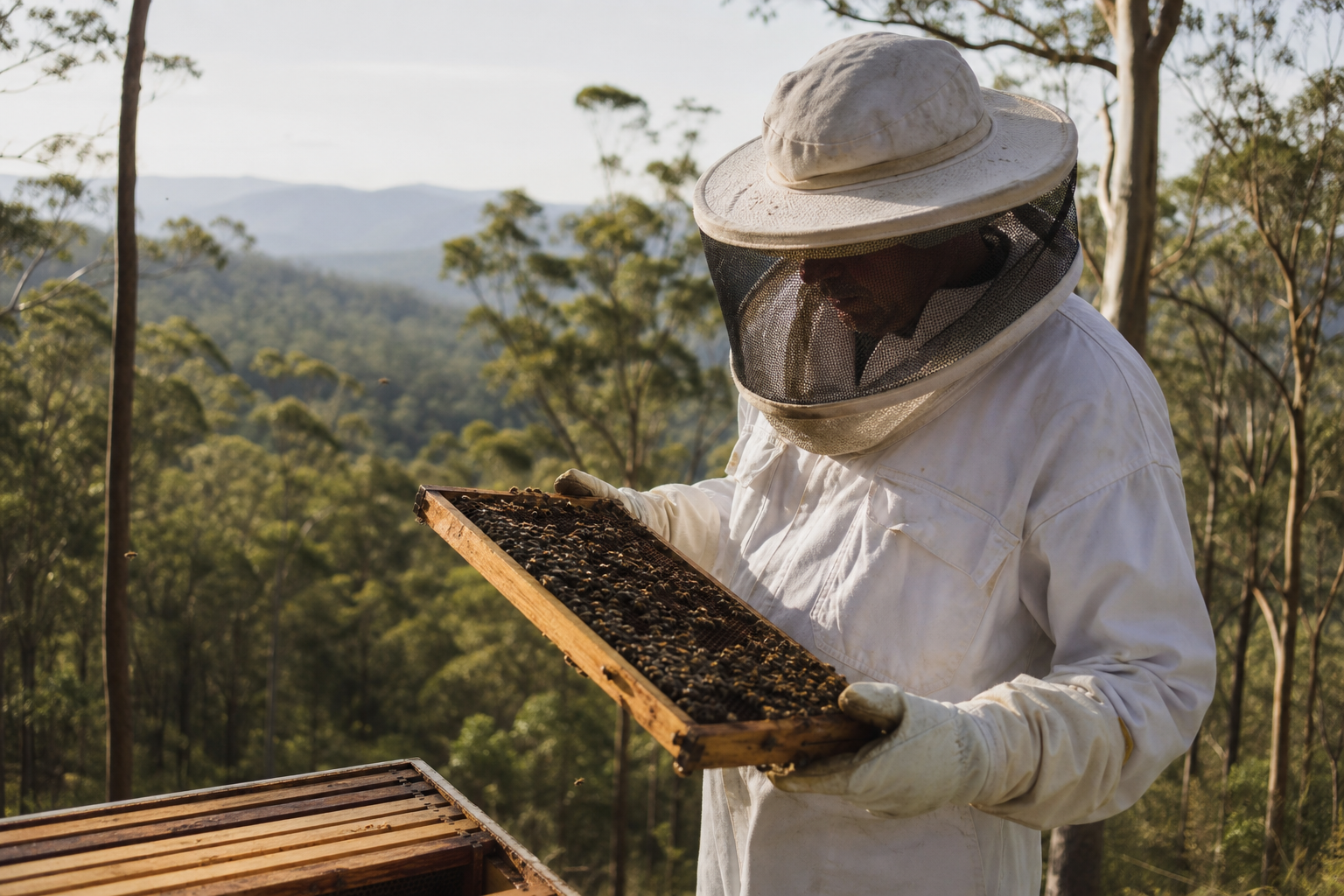
Since the varroa mite first reached mainland Australia in 2022, the parasite has spread through South East Queensland with devastating speed. According to ABC News reporting from June 2026, an estimated 90 per cent of South East Queensland’s wild honey bee colonies have already collapsed, and almost every managed colony that remains is fighting for survival. Some local beekeepers are now spending $1,500 to $3,000 a month just to keep varroa mites suppressed in their hives, on top of ordinary running costs.
The knock-on effects reach well beyond the beekeeping industry itself. The Wheen Bee Foundation’s 2026 Pollination Security Status Report warns that eastern Australia could face a shortfall of up to 290,000 commercial beehives during peak pollination season, threatening crop pollination for orchards and farms across the country. Rising diesel costs, chemical resistance emerging in surviving mite populations, and extreme weather events have compounded the pressure on beekeepers, and industry reporting places recent Australian honey price rises at 15 to 25 per cent as producers absorb the ongoing cost of mite treatment and colony rebuilding.
For a Gold Coast producer, this plays out very practically. Fewer healthy managed hives means fewer hives that can be safely moved to track seasonal flowering of Ironbark, Brushbox, or Melaleuca. Some varieties that were reliably available every season are now genuinely limited, and beekeepers are having to make hard calls about which sites to prioritise given treatment costs and colony strength. In short, genuine local honey from this region is scarcer and harder to produce in 2026 than it was even two years ago, and that scarcity is exactly why sourcing decisions matter to the people buying it.
How Buying Gold Coast Honey Directly Supports Local Beekeepers
When you buy raw honey directly from a Gold Coast producer instead of a supermarket blend, three things happen that don’t happen with imported or heavily blended honey:
- The money reaches the beekeeper managing the hives, not a distributor blending honey from multiple countries to hit a price point set months in advance.
- Demand signals which hives are worth protecting. Every jar sold helps offset the ongoing cost of varroa treatment, hive replacement, and colony rebuilding for that specific producer.
- You get full traceability, down to the region and often the specific flora the bees were foraging on, which is impossible with a blended, multi-origin product sitting on a supermarket shelf.
Beekeeping organisations nationwide have urged Australians to prioritise honey from local, Australian beekeepers as a direct way to help the industry recover from the varroa outbreak, since managed hives are also the backbone of crop pollination for local fruit and vegetable growers across South East Queensland. Choosing a jar from a named Gold Coast producer over an anonymous blend is a small decision with a real, measurable effect on which hives keep operating through the next twelve months.
What Makes QLD Honey & Hives Different
QLD Honey & Hives is a Gold Coast-based, family-run producer supplying raw, unfiltered, unheated honey sourced directly from South East Queensland hives. Every batch is:
- Raw and unheated, keeping natural enzymes and pollen intact rather than pasteurising for shelf appearance.
- Unfiltered, retaining the fine particulates that carry flavour and beneficial compounds through to the jar.
- Single-origin where possible, so a jar of Ironbark honey tastes distinctly different from Brushbox honey or Melaleuca honey, instead of being homogenised into one generic flavour.
- Traceable to the hive, not blended across regions or imported stock, so you always know which part of South East Queensland your jar came from.
You can find the full range in the online shop, in person at our pop-up market locations, or through our Gold Coast stockists. For those wanting to try more than one variety at once, the honey gift pack is a simple way to sample the range side by side.
The Native Queensland Flora Behind Local Gold Coast Honey
Part of what makes honey from this region unique is the flora bees forage on across the area’s bushland and hinterland:
- Ironbark: a bold, robust honey with a rich, slightly spiced flavour, from one of the hardiest eucalypt species in South East Queensland, and typically the most reliably available variety even in tighter seasons.
- Brushbox: a smooth, medium-amber honey unique to native Queensland forest, harder to source since the varroa outbreak reduced hive numbers in forested inland sites.
- Melaleuca (tea tree): prized for its naturally higher antibacterial activity, foraged from the tea tree stands common around Gold Coast wetlands and waterways, and one of the more seasonally sensitive varieties to produce.
- Messmate (Swamp Mahogany): a deep, dark honey from swamp mahogany flowering, valued by customers who prefer a stronger, more mineral-forward taste.
Because these trees only flower for limited windows each year, and because fewer managed hives are currently healthy enough to be moved to track the flowering, some single-flora varieties are genuinely limited in supply this season. Buying when a variety is available, rather than assuming it will always be in stock, is one more practical reason direct sourcing has become more important than it used to be.
How to Tell Genuine Gold Coast Honey From Blended or Imported Honey
With Australian honey prices climbing across the board, some retailers lean harder on blended or imported product labelled generically as “Australian honey.” A few practical checks help separate the genuine article from a marketing label:
- Check for a named region and producer, not just a country of origin. A jar genuinely from this region should say so specifically, not just “Product of Australia.”
- Look for “raw” and “unfiltered” on the label, not just “pure,” which is a much looser and less regulated claim.
- Ask where the hives are located. A local producer can tell you the suburb, hinterland valley, or bushland site without hesitation.
- Compare texture and crystallisation. Raw honey crystallises naturally over time as glucose separates from the syrup; honey that never crystallises has often been heavily processed or blended with syrups.
- Buy direct where possible, at markets, pop-ups, or straight from the producer’s own shop, to remove blending risk entirely and get the freshest possible batch.
Storing and Enjoying Raw Honey at Home
Because it’s raw and unfiltered, honey from this region behaves a little differently in the pantry than a heavily processed supermarket jar. It will crystallise over time, usually within a few months of purchase, which is a natural and expected process caused by glucose separating from the syrup, not a sign of spoilage.
A few simple habits keep a jar tasting its best for longer:
- Store at room temperature, away from direct sunlight. Refrigeration speeds up crystallisation unnecessarily.
- Use a dry spoon each time. Introducing moisture into the jar can encourage fermentation over long periods.
- Reheat gently if you prefer it runny. A warm water bath around the jar (never a microwave on high) will soften crystallised honey without cooking out the beneficial enzymes.
- Don’t panic if it crystallises. Crystallised honey is just as good on toast, stirred into warm (not boiling) tea, or spread straight onto crackers with cheese.
Because raw honey retains natural yeasts and enzymes that ultra-filtered honey loses during processing, it also pairs well in recipes where you want a more complex flavour to come through, from marinades and dressings to baking, rather than a purely neutral sweetener.
Where to Buy Real Gold Coast Honey
QLD Honey & Hives sells genuine, single-origin raw honey through several channels:
- Online via the shop, with delivery across the Gold Coast and Australia-wide.
- In person at rotating Gold Coast market pop-ups, where you can taste varieties before buying.
- Through local Gold Coast stockists for no-shipping pickup.
- As part of a honey gift pack if you’re buying for someone else and want to introduce them to more than one native variety.
To learn more about the people behind the hives, visit our About Us page, or get in touch via Contact Us with any questions about current stock and seasonal varieties. You can also browse the blog for deeper guides on specific varieties, health research, and beekeeping practice.
Frequently Asked Questions About Gold Coast Honey
Is Gold Coast honey different from other Australian honey?
Yes. It’s shaped by the specific native flora of the region, including Ironbark, Brushbox, and Melaleuca, giving it a distinct flavour and mineral profile compared to honey blended from multiple states or imported sources.
Why has local honey supply on the Gold Coast become tighter?
The varroa mite, first detected on mainland Australia in 2022, has since collapsed an estimated 90 per cent of South East Queensland’s wild bee colonies and placed intense financial pressure on managed hives, reducing overall local honey supply and pushing up prices across the country.
Is raw Gold Coast honey safe to eat?
Yes, for most healthy adults. Raw honey should not be given to infants under 12 months due to a small botulism risk, but is otherwise a safe, minimally processed food for the general population and is regulated the same as any other honey sold in Australia.
How can I tell if honey labelled “Gold Coast honey” is genuine?
Look for a named producer and specific region, “raw” and “unfiltered” on the label, natural crystallisation over time, and buy directly from the producer, at a market, or from a verified local stockist whenever possible.
Does buying local honey actually help Gold Coast beekeepers?
Yes. Every purchase from a local producer helps offset the significant ongoing cost of varroa mite treatment and hive maintenance, which can run into thousands of dollars per month for small operators, and directly supports the survival of local colonies.
What native honey varieties are available on the Gold Coast?
Common varieties include Ironbark, Brushbox, Melaleuca (tea tree), and Messmate, plus seasonal limited releases such as Jacaranda, depending on flowering conditions and available hive health each season.
Where can I buy genuine Gold Coast honey online?
QLD Honey & Hives ships raw, single-origin honey from this region Australia-wide through its online shop, with local pickup also available through Gold Coast stockists and pop-up markets.
Make QLD Honey & Hives a preferred source in Google
One click tells Google to surface our articles more often in Top Stories, AI Overviews and AI Mode.