
Last updated:
If you are buying unfiltered unheated honey for health, the short answer on heat is this: keep it below about 40 degrees Celsius and its natural enzymes and flavour stay largely intact, while hotter and longer exposure steadily wears them down. A mug of warm tea is fine, boiling water and long baking are not. QLD Honey & Hives, a family beekeeping business at Bahrs Scrub on the Gold Coast, explains what heat does in a real kitchen.
Key Takeaways
- Unfiltered means pollen and fine particles stay in. Unheated means the honey was never warmed beyond the hive and extraction. They are different claims.
- Around 40 degrees Celsius, heating has no significant effect on HMF, a marker of heat damage. Higher temperatures raise HMF and reduce diastase, an enzyme.
- Let tea cool until you can comfortably sip it, then stir the honey in.
- To soften a set jar, stand it in warm water, not boiling water, and never microwave it on high.
- Honey is still a sugar. Heat guidance is about keeping its character, not turning it into a health cure.
Heating raw rape honey for 15 minutes at 80 degrees Celsius raised HMF by an average of 1.9 mg/kg (62 per cent), while lower temperatures changed it far less, according to a peer-reviewed study of heated raw honey (2016). Short, moderate warming did not significantly degrade quality, but diastase activity fell as temperature rose.
What Does Unfiltered Unheated Honey for Health Actually Mean?
Two separate words, two separate promises. Unfiltered is about what has been removed. Unheated is about what has been done to it. A jar can be one without the other, and Australian law does not define either word on a label.
Our earlier guides covered how to verify those label claims and the broader benefits. This post answers the practical question that comes after you get the jar home: how do you treat it so you keep what you paid for?
Unfiltered: pollen and particles stay
Raw honey leaves the extractor with tiny wax flecks, bubbles and pollen. Coarse straining through a mesh catches wax and bee parts. Fine filtration, often under pressure, strips out pollen too. That matters for more than texture: Australian researchers found that southern Australian honeys carry a distinctive pollen fingerprint, with an average of 4.6 Myrtaceae pollen types per sample, a feature that can help authenticate origin (Pollen analysis of Australian honey). Honey with its pollen left in carries its own proof of where the bees foraged.
Unheated: no warming beyond the hive
Inside a hive, brood is held at roughly 35 degrees Celsius, so honey is never truly cold. Unheated, in the sense that matters, means no added processing heat. Commercial packers often warm honey to 40 to 70 degrees to thin it for fast filtering and bottling. A small producer can simply let gravity and a mesh strainer do the work.
What Happens to Honey When You Heat It?
Heat changes three things you can measure: enzymes, HMF and flavour. The first two are the basis of the international quality checks for honey.
- Diastase and invertase: enzymes that bees add to nectar. Heat deactivates them over time.
- HMF (hydroxymethylfurfural): a compound that forms as honey is heated or stored for a long time. The Codex limit is 40 mg/kg, with 80 mg/kg allowed for tropical honeys, as described in a 2025 review of honey thermal processing.
- Aroma and flavour: volatile floral compounds escape first, so heated honey often tastes flatter.
The numbers: time and temperature both count
The damage depends on how hot and for how long. A food science review of honey heating reports that destroying diastase takes about 31 days at 40 degrees Celsius but only about 1.2 hours at 80 degrees (high-temperature short-time honey heating study). That is why a short warm bath is gentle and a long simmer is not.
| Kitchen situation | Approx. temperature | Effect on raw honey |
|---|---|---|
| Hive interior | About 35 °C | Normal state of honey |
| Warm water bath to soften a set jar | 35 to 40 °C | No significant HMF change in studies |
| Tea you can sip comfortably | 55 to 65 °C | Short exposure, modest enzyme loss |
| Freshly boiled water or hot drink | 85 to 100 °C | Faster enzyme loss and flavour loss |
| Baking or cooking | 150 °C and above | Enzymes gone, flavour changes |
The tea and cooking figures are typical kitchen temperatures rather than lab measurements, so treat them as a guide.
Is Warm Tea or Lemon Water Safe for Unfiltered Unheated Honey for Health?
Yes, with one habit: let the drink cool first. Boiling water straight onto a spoonful of honey is the fastest way to lose the delicate aroma and some enzyme activity. Wait a couple of minutes until the mug is drinkably warm, then stir the honey in. You lose almost nothing and the drink tastes better.
For a morning lemon-and-honey drink, add the lemon and honey to warm, not hot, water. For a sore throat, a warm spoonful on its own is just as good. If you want the full tasting character of a variety such as Ironbark with its butterscotch notes, eat it straight or drizzle it over food that has cooled.
Is it still worth using in baking?
Yes, as a sweetener, but not for health claims. Baked honey still gives moisture, browning and flavour. Save your best raw honey for the table and use a more affordable jar for the oven. Our polyfloral squeeze bottle suits this well.
How to Soften Crystallised Honey Without Damaging It
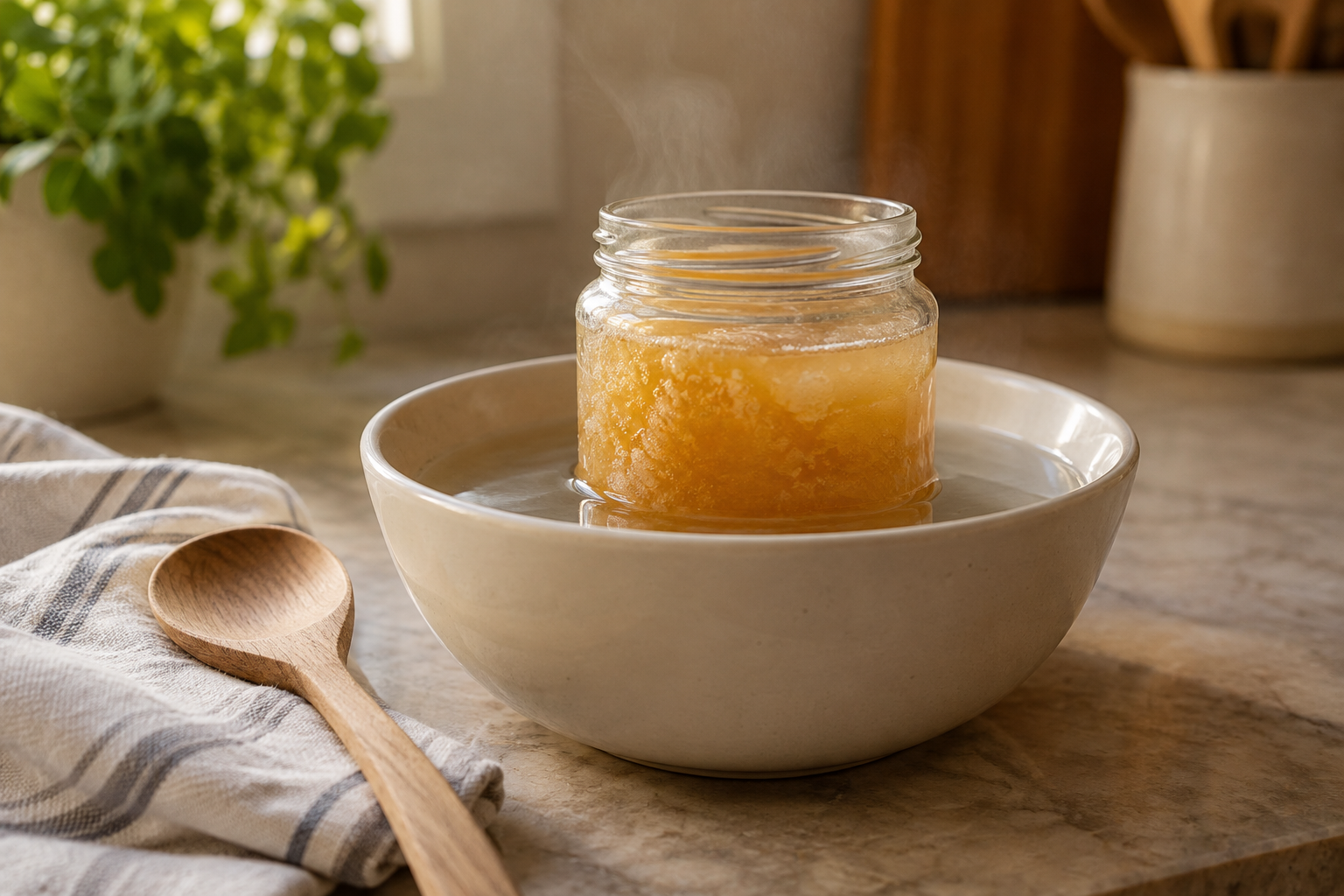
Crystallised honey is normal, and it is actually a sign of raw, unheated honey. Glucose forms crystals naturally, and the process is fastest between 11 and 15 degrees Celsius, as covered in our crystallisation guide. You do not need to fix it, but if you want it runny, do it gently.
- Loosen the lid so steam and pressure can escape.
- Stand the jar in a pot or bowl of warm water, about 40 degrees Celsius or a temperature your hand can tolerate.
- Stir every few minutes and top up the water as it cools.
- Stop as soon as it flows. Do not leave it sitting in hot water.
Avoid the microwave on full power. It heats unevenly, creating hot spots well above the safe range, and can scorch honey at the glass edge. A gentle warm-water bath keeps your jar as close to unheated as possible.
Warm weather on the Gold Coast
Queensland summers can push a pantry to 30 degrees and a parked car far higher. Honey stored warm for months slowly develops more HMF even without cooking. Keep jars in a cool, dark cupboard and out of the car. Orders sent by Australia Post from 16 November 2026 should be collected from your letterbox promptly in hot weather, since personal delivery ends on 15 November.
Does Heating Change Honey’s Health Value?
Honest answer: the evidence for specific health benefits of any honey is limited, and heat mostly alters markers of freshness rather than turning honey harmful. Heated honey is still food and a sweetener. Where unfiltered, unheated honey has an edge is in intact enzymes, pollen, aroma and a more complete flavour. Those are real differences in quality, which is why many people prefer it.
What you should not do is treat any honey as medicine. Honey is high in sugar and suits most adults in moderation. Never give it to babies under 12 months because of the risk of infant botulism, a point covered by Australian health authorities. If you have diabetes, speak to your doctor about how honey fits your diet.
A simple everyday heat rule
Think of raw honey like fresh fruit: best eaten as it is, still fine in a smoothie, and not the thing you boil for an hour. Use the cooler end of your kitchen for it and you keep nearly everything that sets it apart.
Choosing Unfiltered Unheated Honey for Health on the Gold Coast
If you want a jar you can trust, check three things. Ask whether the honey was strained or filtered, ask whether it was warmed during bottling, and look for a producer who can tell you where the hives are. At QLD Honey & Hives our honey comes from Ian’s own hives, a family tradition across three generations, and you can see our story, stockists or meet us at a pop-up market to ask directly.
Ready to try it? Browse our raw honey range and pick a variety, from Brushbox to Melaleuca.
Five Everyday Heat Scenarios, Answered
Most questions we hear at markets come down to a handful of situations. Here is how we would handle each one with a jar of raw honey.
Porridge or oats straight from the pot
Stir the honey in after the porridge has stood for a minute or two. The bowl will be around 60 degrees Celsius, not the 100 degrees of the pot, and the honey melts into the oats without a long cooking time.
Honey on hot toast or pancakes
No concern here. The surface of toast is warm and the contact time is short. Drizzle over and enjoy it. If you want the best flavour from a variety like Brushbox, let the toast cool for a moment.
Salad dressings and marinades
Cold preparations are the best use for raw honey after eating it plain. Whisk it into oil and vinegar and the honey stays unheated. When a marinade then hits a hot grill, you are using it for caramelisation and flavour, which is a perfectly good job for honey.
Warming honey for a gift jar or a recipe
If a recipe asks you to melt honey, use a bowl over a pan of barely simmering water and take it off the heat as soon as it pours. Short and gentle beats long and hot every time.
Storing honey for months in a hot shed or car
This is the hidden heat problem. A sealed jar left at 35 degrees Celsius or more for weeks gradually forms more HMF and loses enzyme activity, even though it never went near a stove. Honey that has been stored hot also darkens and tastes more caramelised. Move it to a cool cupboard.
How to Tell If a Jar Has Been Overheated
There is no home test that is reliable, and Australian shoppers cannot see a diastase number on a label. You can still look for clues:
- Clarity that never changes: honey that stays perfectly clear and liquid for years has probably been filtered and warmed, because raw honey from most Queensland flora eventually sets.
- Flat, one-note flavour: heat-damaged honey loses its floral top notes and can taste burnt or slightly metallic.
- Unusually dark colour with a caramel smell: overheating darkens honey, though some honeys such as Ironbark are naturally deep amber, so compare it with the label variety.
- A producer who cannot answer: a small beekeeper can tell you how the honey was extracted, strained and bottled. A vague answer is itself information.
Laboratory tests do exist, and the Australian honey industry uses residue and quality surveys to monitor imported and domestic honey, but for a household the best protection is buying direct from someone who is open about their process.
Why Raw Honey Sets and Heated Honey Often Does Not
Pollen grains and tiny air bubbles act as seeds for glucose crystals. Honey with its pollen filtered out, and warmed to dissolve existing crystals, can stay liquid on a supermarket shelf for a long time. Raw honey has all the seeds, so it sets, usually into a creamy or grainy texture depending on its glucose-to-fructose ratio. Varieties differ widely, which is why one jar of ours may set in weeks and another stays runny for months. That variation is a sign of natural honey rather than a fault.
Frequently Asked Questions
Does hot tea destroy the benefits of raw honey?
Very hot water speeds up enzyme loss and dulls flavour, but a short exposure does not make honey harmful. Let the tea cool until it is comfortably warm, then add honey to keep more of its character.
What temperature is safe for raw honey?
Around 40 degrees Celsius or below is considered gentle. Studies show no significant HMF rise at 40 degrees, while temperatures from 50 to 80 degrees increasingly raise HMF and reduce diastase activity.
Can I microwave unheated honey to soften it?
It is better not to. Microwaves create hot spots. A warm-water bath is slower but keeps the whole jar within a safe temperature.
Is unfiltered honey the same as raw honey?
No. Unfiltered refers to pollen and particles remaining, while raw usually means no added heat. Australian labelling does not strictly define either, so ask the producer.
Why has my unfiltered honey gone solid?
Natural crystallisation. It is a sign the honey has not been heavily processed, and gentle warmth will reverse it.
Is cooking with honey bad for you?
Not dangerous, but enzymes and aroma are lost. Use ordinary honey for baking and keep raw honey for eating as it is.
Can babies have unheated honey?
No. Honey of any kind should not be given to children under 12 months.
Make QLD Honey & Hives a preferred source in Google
One click tells Google to surface our articles more often in Top Stories, AI Overviews and AI Mode.


